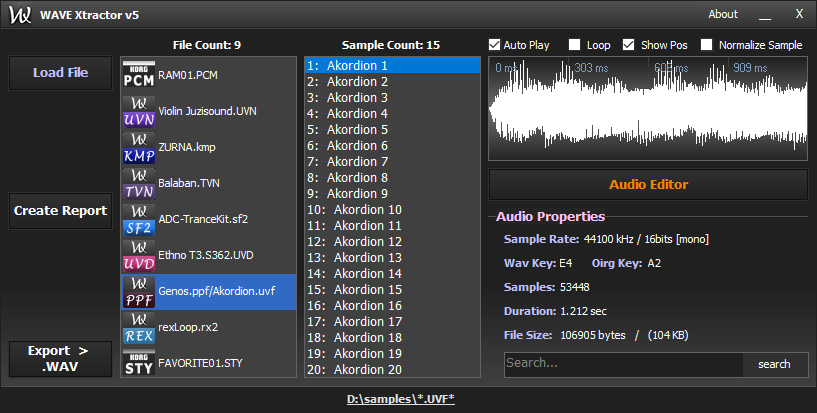
Extract .Wav sample data from KORG, Yamaha and other popular File formats.
Build: 02 January 2026
File Size: 5.20 MB

Through interviews and midnight stakeouts, Arjun began to see the Killer’s pattern—not merely in victims but in audience. Each killing was timed to an exposure: a press conference, a gala, a televised prayer. The Killer engineered revelation as spectacle, forcing society’s gaze onto the fissures it preferred to ignore. News cycles erupted as citizens watched justice performed in a manner their courts could not provide. For some, the Killer was executioner; for others, a bitterly necessary surgeon.
The arrest that followed was not triumphal. The public split—some saw an unambiguous victory for law; others mourned the loss of an avenger who had given voice to the silenced. Vikram’s trial exposed ugly truths: corporate malfeasance, institutional laziness, and the human cost of deferred justice. Arjun testified not out of duty alone but with the weight of one who had come to understand the logic of vengeance without condoning its moral calculus.
Arjun confronted Vikram in an abandoned train depot, sunlight slicing through broken glass. Vikram’s face was older than his file, eyes glassy with a clarity that bordered on fanaticism. He did not deny the killings. “They made calculus of human lives and called it policy,” Vikram said, palms open as if offering a final balancing. “I made a ledger of faces and called it correction.” the killer 2006 filmyzilla exclusive
Maya Singh, an investigative journalist with a knack for seeing what others missed, became Arjun’s reluctant ally. She found that the rose was never just a rose: hidden in its stem was a slip of paper—an excerpt from a case file, an affidavit, a page from a ledger—documents that implicated networks rather than single bad actors. The Killer’s weapon was exposure; the wounds were legal and reputational as much as mortal.
In 2006, a shadow moved through the neon-lit alleys of a city that never truly slept. Rumors whispered of a figure—calm, deliberate, and unsparing—whose arrival left a neat signature: a single crimson rose folded into the palm of every victim. Papers labeled the phantom “The Killer,” while late-night callers swore they’d glimpsed a silhouette disappearing into smoke above the river. The press called it a spree; the streets called it a reckoning. Through interviews and midnight stakeouts, Arjun began to
Maya published a long piece that refused to romanticize the murders. She chronicled the victims’ sins and their humanity, Vikram’s trauma and discipline, Arjun’s struggle between law and empathy. Her final lines circled back to the rose: an exquisite, terrible emblem of the choices a society makes when it tolerates small cruelties. The Killer had been stopped, but the conditions that made his narrative resonate persisted.
Detective Arjun Rao had seen too many endings to mistake this for ordinary violence. Each scene bore contradictions: surgical precision in the wounds, forensic evidence wiped clean, and a calling card that felt almost ritual. The Killer did not kill for money, envy, or rage. The Killer killed to tell a story—one told in a language of punishment and poetry. News cycles erupted as citizens watched justice performed
In the aftermath, the city did not become pristine. Laws changed in small ways; hearings were convened; names were called to testify. But the Killer’s legacy proved complicated. For every reform cited, someone could point to another life that still hung on the authority’s indifference. The rose remained a symbol—not of unequivocal heroism, nor of pure villainy—but of a fracture in the social compact: when institutions fail consistently, some will write their own verdicts in blood.
This will take you through PayPal, to complete the payment.
*approx €30 Eur
1 License [1 PC]
Free updates
Technical support
Refunds can only be accepted if you have not received your Activation Code.
Social Media: