Everything Investigator Girl Better -
Once, in a city of dim alleys and bright curiosities, there was a young investigator known to some as Girl Better. The name began as a joke—she solved cases "better" than anyone else—but it became a promise she kept every day. This essay traces what made her better: her curiosity, methods, relationships, and the quiet ethics that guided her choices. Curiosity as Engine Girl Better’s advantage began with curiosity that refused closure. Where others accepted tidy answers, she treated each fact as a door. Curiosity drove her to linger at crime scenes after the lights went out, to read obscure manuals, and to learn the handwriting styles of long-forgotten clerks. That persistent interest transformed fragments into patterns. She did not collect facts to prove herself right; she assembled them to understand what had actually happened. Method: rigorous, creative, and patient Her methods combined rigor with creativity. She kept detailed notes and timelines, cross-checked statements, and used redundancy to test witness claims. But she also embraced imaginative leaps: reconstructing scenes with clay models, roleplaying conversations to test tone, and using unlikely analogies to spot hidden motives. Patience let her wait for patterns to emerge; discipline kept her from leaping on coincidences. Being “better” meant balancing skepticism with openness—always testing hypotheses, never idolizing them. Attention to People Girl Better treated people as more than sources. She listened for what wasn’t said: hesitations, contradictions, or small habitual phrases that revealed fear or guilt. She respected dignity even when questioning suspects, which often loosened tongues. That humane approach yielded information that forceful interrogation never would. Her empathy did not cloud judgment; it refined it, because understanding motives makes the rest of the evidence fall naturally into place. Tools and Craft She mastered both old and new tools. A magnifying glass and typewriter knowledge were as valuable as digital forensics and encrypted messaging techniques. She appreciated provenance—knowing where evidence came from and how it might be altered. Her toolkit was practical and evolving, which is what made her resilient: when one method failed, another filled the gap. Ethics over Showmanship What distinguished Girl Better most was ethics. She resisted shortcuts that promised quick wins at the cost of truth. She did not fabricate leads, coerce confessions, or exploit the vulnerable for success. Honesty earned her reliable allies: prosecutors who trusted her reports, journalists who checked her facts, and communities who welcomed rather than feared her presence. Her reputation for integrity often turned adversaries into collaborators. Learning from Failure She was better because she learned from failure. Every misread clue and false lead became training—notes to revise, routines to improve. Rather than burying mistakes, she cataloged them. That humility prevented hubris and kept her methods adaptable. Improvement, to her, was iterative: small course corrections that compounded over time. The Cultural Role of the Investigator Beyond individual prowess, Girl Better embodied a cultural need: the restoration of coherent narrative from chaos. In societies saturated with rumor and partial truths, an investigator who seeks full context performs a civic function. She did not merely solve puzzles; she re-established facts, enabling justice and communal healing. Her work reminded people that facts matter and that careful inquiry can reclaim public truth. Conclusion: Better as a Practice “Everything Investigator Girl Better” is not merely a claim of superiority but a portrait of better as practice. Curiosity, disciplined method, humane attention, evolving tools, rigorous ethics, and learning from failure compose a durable approach to inquiry. To be better is not to be infallible; it is to commit to practices that increase fidelity to truth. In that commitment, Girl Better’s legacy is practical and contagious: any investigator—professional or citizen—can adopt these habits to make their work, and their community, better.
The program can do so many things — this list is far from complete
- Do conversions from the 400+ audio related file formats that it can read, into any of the 260+ formats that it can write.
- Read and write the instrument formats of many commercial synthesizers, hardware modules, and software synths —
including formats from AKAI, Ensoniq, Korg, Kurzweil, Roland, Yamaha, Native Instruments, and many more.
High quality conversion can be made between most formats, preserving important synthesis parameters such as envelopes and LFOs.
- Read several disk formats that cannot normally be accessed by Windows, including CDs from AKAI S-1000, AKAI S-3000, E-mu Emulator III, Kurzweil, and Roland S-5xx and S-7xx series.
- Up to 32-bit floating point data precision for mono and stereo data.
- Fully supports SF2 and DLS level 2, as well as a large subset of SFZ v2.
- You can also use it as an editor for many other synths — for some, it is the only PC editor.
- Data is organized in an easy-to-use three pane layout — with a hierarchical instrument tree to the left, a waveform list in the middle, and a property inspector to the right.
- Graphical editors for instrument parameters — e.g. the much-applauded loop editor that lets you easily find the best loops.
- Edit parameters for multiple items simultaneously — as quickly and easily as you edit a single item.
- Audition, i.e. play & listen to, instruments directly using the PC keyboard or an external MIDI keyboard.
- Convert song data between several formats (e.g. MOD-tracker modules into SMF accompanied by custom instruments).
- Render your songs into audio clips with superior audio quality using the bult-in software synthesizer.
- Convert FM-synthesis instruments into sampled instruments — with support for all major Yamaha DX-series SysEx formats.
- The Batch conversion tool makes converting large numbers of audio files extremely simple — including optional effects processing.
- Processing functions help you with tasks such as resampling, fading, merging, splitting, normalizing, or searching and replacing text metadata.
- The Audio recording function not only records audio, it can also automatically sample any MIDI or VSTi 2.x instrument.
Ok, so what doesn't it do?
It can only do very basic low-level MIDI event editing (look elsewhere for a sequencer).
It won't handle more than 2 audio channels (so no surround sound).
It needs to fit all audio data into memory (but RAM is plentiful today).
It can't transcribe audio recordings into MIDI notes (try an AI tool for that).
If you are unsure if it is for you — then why not download the free 30 day trial version? Seeing is believing!
You can try almost all functionality — we don't hide any ugly surprises — we have confidence in our product.
→ Screenshots…
Screenshots
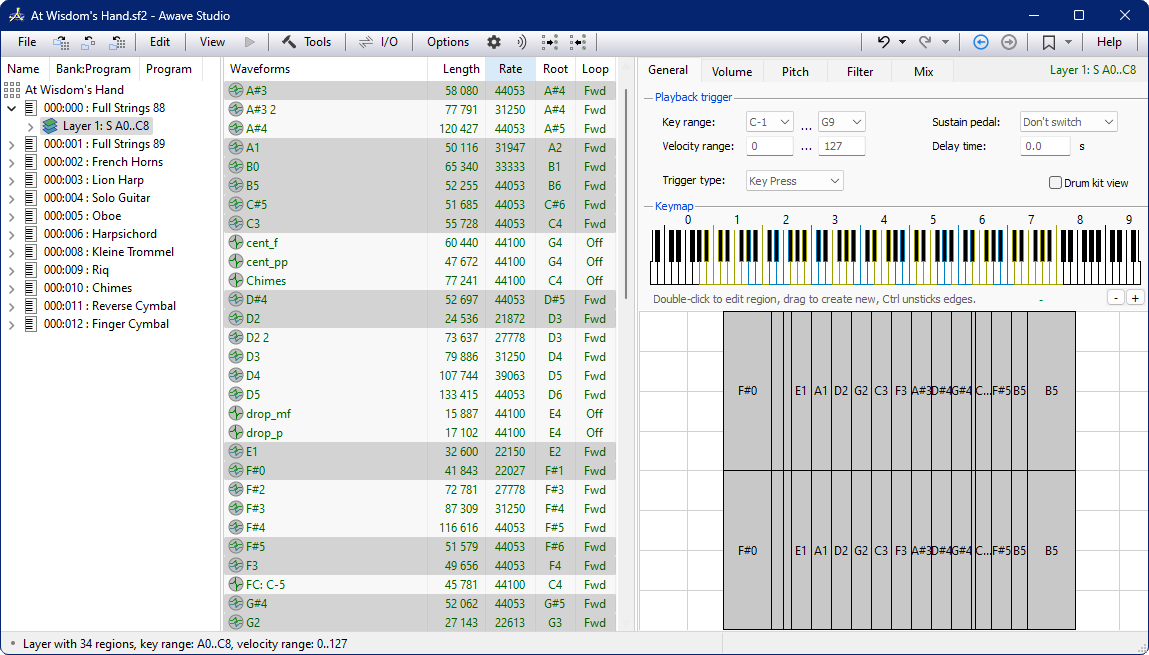
Awave Studio main window + Layer general tab with keymap editor
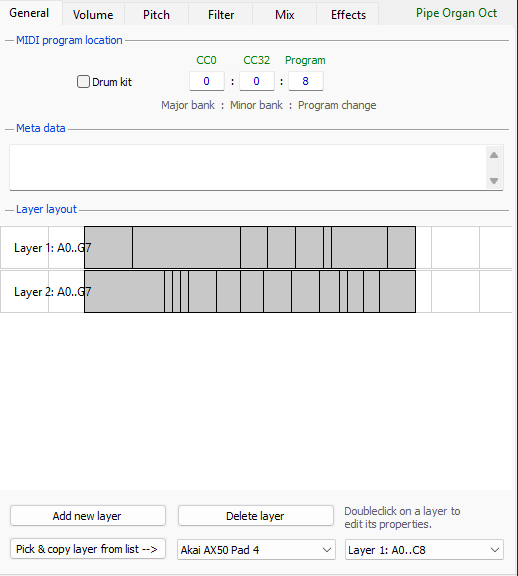
Instrument general tab with layer overview
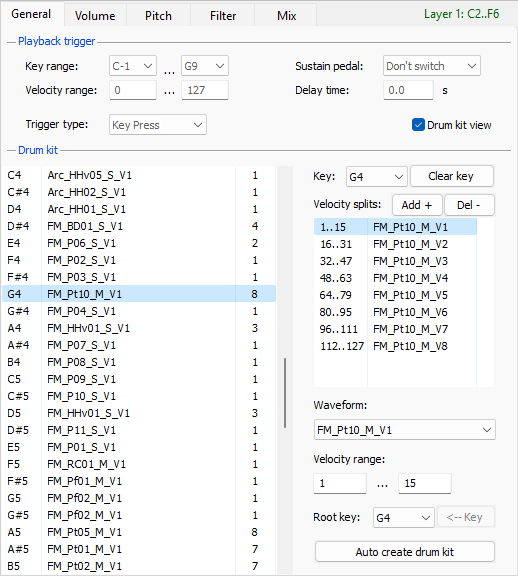
Layer general tab with drum kit editor
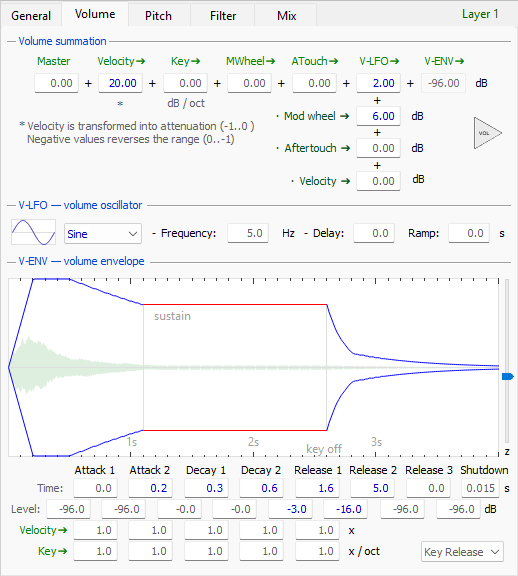
Volume articulation tab, with lfo and envelope editor
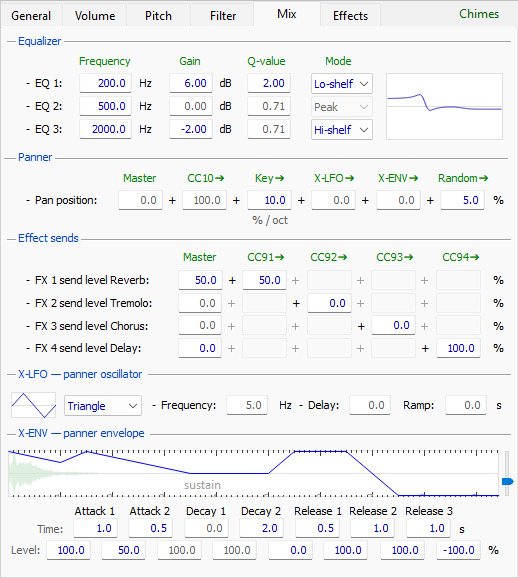
Mix articulation tab, with EQ, panner and sends
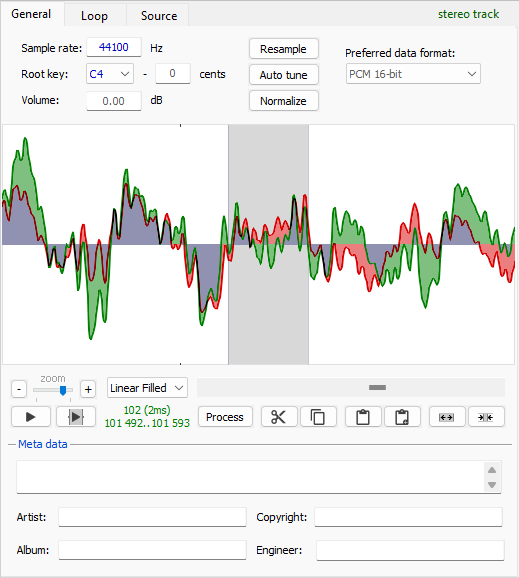
Waveform general tab, with the waveform editor
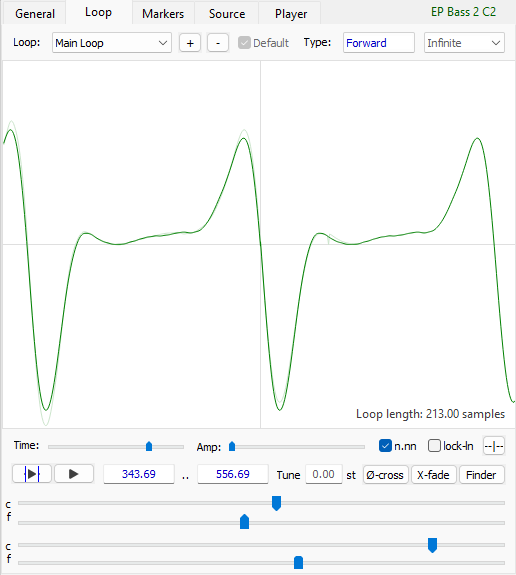
Waveform loop tab, with the loop point editor

Audio recording - step 1 - Setup and config

Audio recording - step 2 - Recording and post-processing
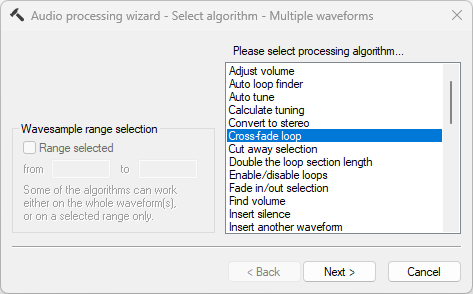
Audio processing - step 1
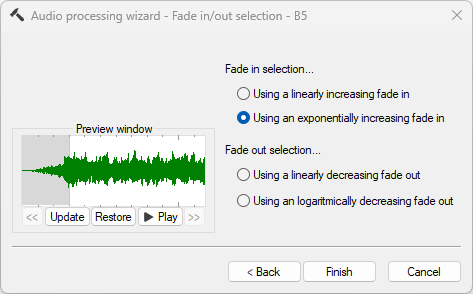
Audio processing - step 2 (example)
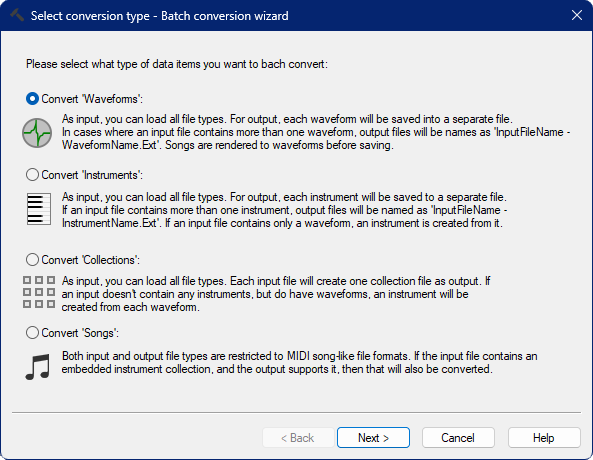
Batch Conversion tool - Step 1: Select batch type
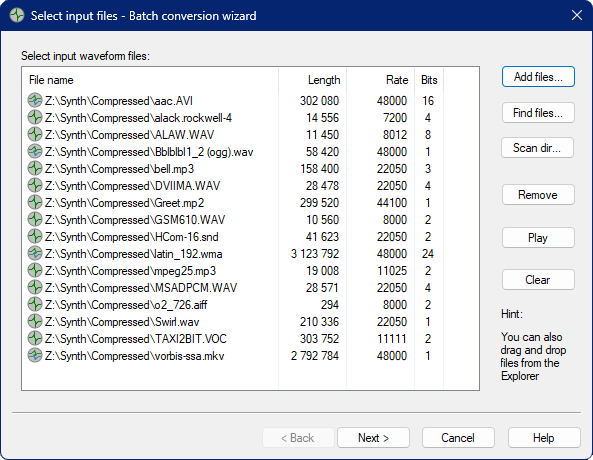
Batch Conversion tool - Step 2: Select input files
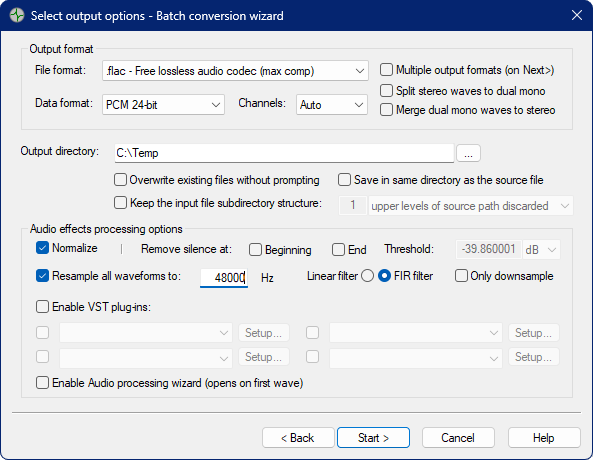
Batch Conversion tool - Step 3: Select output options
Awave Studio is commercial software marketed as Shareware.
This means that you get to "try it before you buy it".
If you find that you like it, and wish to continue using it past the 30 day free trial period, then you need to buy a license.
Note that this software is supported for Windows only
(for other platforms, you can try Wine, but be sure to test it before buying).
Buying it will:
- Remove the "nag screen" and annoying reminders.
- Remove the "restart after each save" limitation.
- Enable locked features — e.g. saving collections and batch conversions.
Buy it on-line here:
All payments are handled by PayPal.
Most credit cards are accepted.
You do not need a PayPal account.
EU-customers: VAT will be added to the price.
* Preferred currency = SEK = Lowest price
License and delivery:
What happens next?
After we have received your order, you will be sent an email with a personal license key file that unlocks the trial version into the full version.
Please note that this is normally sent within 24 hours, but not immediately (also, do check your "spam" or "junk" folders if you don't find it in your in-box).
How may I use it?
What you buy is a single user license.
You are allowed to install it on more than one computer, but you are not allowed to let other persons use it.
The license is personal and issued in your name. It cannot be transferred or resold.
What is your upgrade policy?
We have a policy of minimum one year of free upgrades, meaning that any new major version that may be released within a year from the purchase date, will be free to you. After that period, there may be an upgrade fee. Minor version updates are always free if you own the same major version, regardless of the time that has passed.
Thank you for your order!
If everything went fine with the PayPal transaction, an email containing your reg-code and further instructions should arrive within the next 48 hours.
Please be patient, orders are manually verified before delivery. If you don't see an email, be sure to check you junk-mail folder before contacting support.