Action Matures Tube
With WiFi and Ethernet
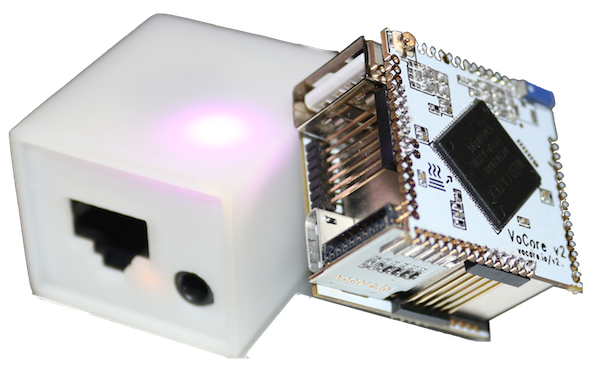
Mini Router only 30g
All-In-One 2.8cm Cube!
Action Matures Tube
Fully source code
Fully layout design
Open for Everyone
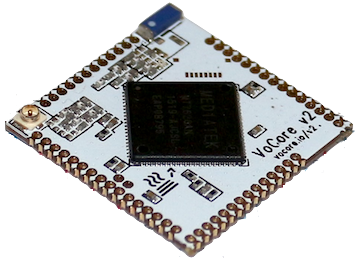
VoCore is open hardware and runs Linux(OpenWrt). It has 128MB DDR, WIFI, USB, UART, SDXC, I2C, SPI, 20+ GPIOs but only one inch square(25.8mm). It will help you to make a smart house, study embedded system or even make the tiniest router in the world.
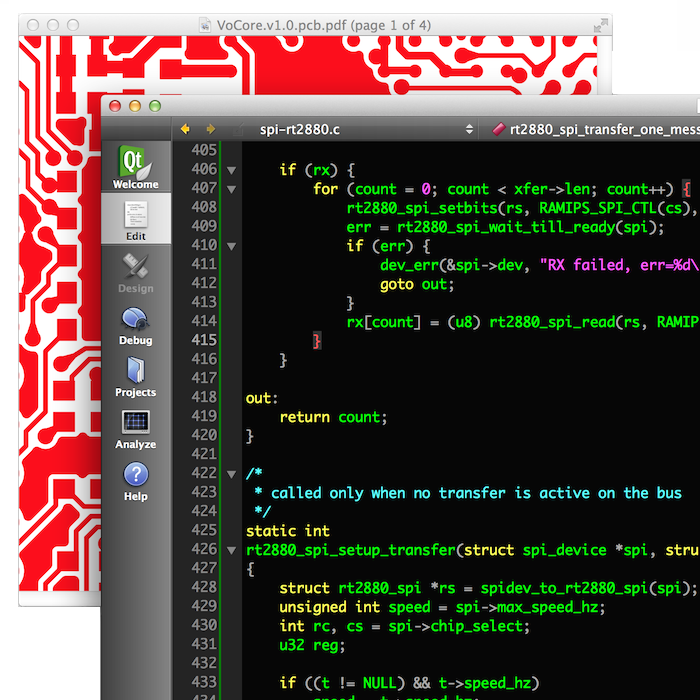
You will not only get the VoCore but also its hardware design including schematic, circuit board, bill of materials and source code of all applications. You are able to control EVERY BIT of your VoCore.
We invite you join us, help our community improve this open source hardware and use your creative skills to make a more wonderful Internet of Things!


Tiny Size: One square inch, easy to embed to devices.
OpenWrt: Easy to code; super stable, three years no reboot.
Low Cost: low cost, less than 1watt, unmatched performance.
Interfaces: Hardware support USB, Ethernet, SD, I2C, SPI etc.
OpenSource: Both software and hardware, totally FREE
Long Life: Keep production over 10 years, fast email support.
Wait, another thought: "action matures tube" might be a misspelling of "action matures tubule," which is a term used in biology, specifically in the context of nephron development. The tubule is part of the nephron in the kidney. So, maybe the user is referring to the maturation process of renal tubules through cellular actions. That could be a possible angle. Alternatively, if we take "tube" literally, maybe it's about the maturation of tubes in mechanical or industrial contexts. But given the mention of "blog post," it's more likely to be a scientific or health-related topic. Let's go with the biological interpretation first.
But I need to confirm if "action matures tube" is a known process. Let me check my knowledge base. In developmental biology, the development of the nephron, which includes the tubule, involves several stages. The metanephric mesenchyme induces the ureteric bud, leading to the formation of the collecting duct and the tubules. The action here could refer to the paracrine signaling interactions between the mesenchyme and the ureteric bud. The maturation of the tubules would involve differentiation of various cell types, such as proximal, distal convoluted tubules, and loops of Henle, each with specific functions. action matures tube
I should structure the blog post with an introduction explaining the importance of tubules in the kidney, then delve into the developmental process, the cellular and molecular actions involved (like Wnt signaling, GDNF, etc.), followed by the maturation steps, and maybe conclude with the clinical relevance if underdevelopment or malfunction occurs (like renal disease or congenital anomalies). Also, maybe mention the role of stem cells in regeneration or repair of tubules in adults. Wait, another thought: "action matures tube" might be
Need to make sure the language is accessible for a general audience, avoiding overly technical terms but explaining necessary ones. Use examples to clarify complex points. Maybe include some recent studies or breakthroughs in the field to make the blog post relevant and engaging. Also, check for any common misconceptions or interesting facts related to the topic. That could be a possible angle